Updated: July 16, 2026
Short answer: check NOAA’s 30-minute aurora forecast. If a G3 or stronger geomagnetic storm is in effect and the Kp index is pushing 7 or higher, central Ohio has a real shot at seeing the Northern Lights. Anything less and you’re probably staying on the couch.
That threshold used to be a once-a-decade event. Not anymore. The sun is near the peak of its 11-year activity cycle, and Ohio has caught visible auroras multiple times since 2024, including the vivid green and pink display over Columbus in October 2024 and the G4 storm that lit up the sky again in November 2025.
How to know if tonight is the night
Bookmark two NOAA pages and you’ll never miss a show:
- NOAA’s 30-minute aurora forecast shows where the aurora is visible right now. If the green oval is dipping toward the Great Lakes, get outside.
- NOAA’s tonight-and-tomorrow viewline gives you a day of lead time, which is the difference between seeing the show and reading about it the next morning.
The number to watch is the Kp index, a 0 to 9 scale of geomagnetic activity. Columbus generally needs Kp 7 or higher for the aurora to clear the northern horizon, and Kp 8 or 9 for the overhead, fills-the-sky version. Storms that strong hit a few times a year during solar maximum.
Where to watch near Columbus
City light is the aurora’s worst enemy. You want dark skies and an open view north:
- John Glenn Astronomy Park (Hocking Hills): the region’s purpose-built dark-sky site, open to the public around the clock for stargazing with your own equipment. Guided programs run Friday and Saturday nights, March through November.
- Alum Creek or Delaware State Park: the closest reliably dark skies north of the city, and north matters, since the aurora sits low on the northern horizon here.
- Rural farmland 30+ minutes out: honestly, any dark spot with an open northern view works. The November 2025 photos in this post were shot in Delaware, Ohio.
Viewing tips
- Watch between 10 p.m. and 2 a.m., when skies are darkest and activity peaks.
- Let your eyes adjust for 15 to 20 minutes. No phone screens.
- Your camera sees more than you do. A 3 to 10 second exposure on night mode will pull out color your eyes read as gray haze.
- Check cloud cover first. A G5 storm behind an overcast sky is still a night on the couch.
Recent Ohio sightings
The most recent major display came on November 11-12, 2025, when a G4 (Severe) geomagnetic storm pushed the aurora over Columbus two nights in a row. 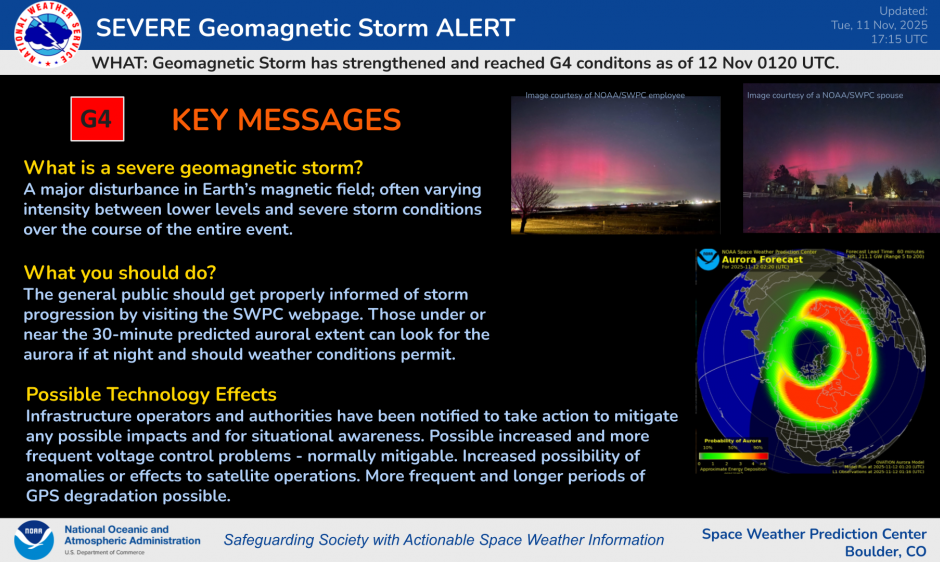 That alert, issued by NOAA’s Space Weather Prediction Center, is exactly the kind of signal worth watching for.
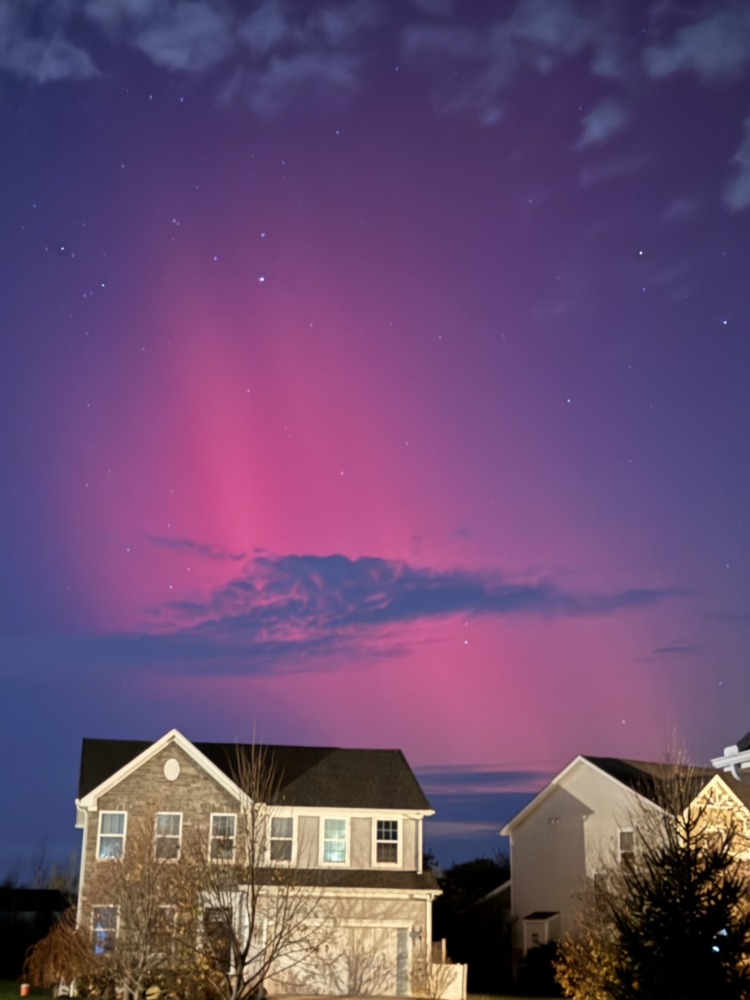
Before that, the October 2024 storm produced one of the most photographed skies in recent Columbus memory. We rounded up reader photos of the Northern Lights over Columbus from that night.

Northern Lights in Ohio FAQ
When is the best time of year? September through April, when nights are long and dark. Summer’s short nights shrink the viewing window.
How often can Ohio see the aurora? A few times a year during solar maximum, which runs through roughly 2026 and 2027. Outside solar max, it can be years between sightings.
Do I need to leave Columbus? For a strong G4 or G5 storm, no. People photographed it from the suburbs in 2024 and 2025. For anything weaker, yes, get to dark skies.