Let’s be honest, these stores were as much a part of your childhood as Surge soda and pizza-flavored Doritos.
Nostalgia is a heck of a thing. It’ll have you reminiscing over the most mundane of memories. Like back-to-school shopping as a kid or loitering around malls after school and cheesing the scene at the food courts.
Columbus’ shopping scene has changed dramatically over the years. Department stores that were once institutions of commerce are now mostly remembered as the venue for arena rock shows. Shopfronts now play host to seasonal costume and party supply stores, but once bustled with families and the warm smiles of kindly old cashier ladies.
We’re going to take the time to remember those now-defunct stores, where we spent our childhoods languidly traipsing behind our parents as they finished shopping.
Big Bear
There was a time when this grocery giant towered over the likes of Kroger and Meijer. The chain slid through the 1990s as management cut costs and customers noticed the decline. When parent company Penn Traffic went bankrupt in 2004, every remaining Big Bear closed for good. Nevertheless, for decades, Big Bear was a Central Ohio staple, having started right here in Columbus in 1934.
For years afterward you could spot their hollow remains in shopping centers all over the city because, frankly, no one had any idea what to do with them. Except maybe turn them into Halloween stores from the months of August to October, which is exactly what happened to most of them.
Schottenstein’s
Schottenstein’s was a discount family shopping center with roots in Columbus going back to 1917, when Ephraim Schottenstein opened the first store on Parsons Avenue. The stores themselves were a lot like Fight Club back in the day. As a teenager, you were allowed to shop there, almost everyone did, but you weren’t allowed to talk about it. To discover that your coat or other clothes were bought at a reasonably priced department store was a faux pas on the fields of middle schools and high schools across the city.
Of course, this was slightly contradictory, as literally, everyone’s parents shopped there for back-to-school clothes. Nowadays the company exists with its hands in many pots, from real estate to commercial lending and even Value City Furniture. Though their department stores closed for good in 2008, the name lives on through the Schottenstein Center, a multi-purpose arena and concert venue.
Buckeye Mart

Another discount department store, Buckeye Mart served as a nameplate for the Gamble-Skogmo conglomerate, which ran several different department stores throughout the U.S. under different branding.
In the Midwest, they were called Tempo Discount Department Stores but in Ohio (particularly in Columbus) they were referred to as Buckeye Mart. Despite their clever localized marketing strategy, the discount marts went out of business in the early 80s.
Gold Circle

Discount department stores never seemed to hold much luck in the Capital City. Another Columbus-based chain, Gold Circle, started in the city in 1967. Its reach grew long and vast, going so far as to have stores in New York. The chain met its end in 1988, when the Campeau Corporation took over its parent company, Federated Department Stores, and sold Gold Circle off to help cover the debt. The last stores closed that November.
Harts Stores
Harts Stores actually got their start operating out of the basements of two different Big Bears stores. Eventually Big Bear bought them out, we all know what happened to those guys, but for a time the stores did really well.
They became the grocer’s compatriot, oftentimes opening up next to each store, selling clothing, toys, and furniture while Big Bear specialized in traditional groceries. Eventually, they doubled down on Big Bear, combining locations to form Big Bear Plus until the chain itself closed for good in 2004.
Sun TV & Appliances
Sun TV was where Columbus bought its televisions and microwaves. Brothers Macy and Herbie Block founded the chain here in 1949, and it grew to nearly 40 superstores across eight states, all run from headquarters on Alum Creek Drive. The pitch was a low-price guarantee, and Sun took it seriously enough to land in a lawsuit war with rival Fretter over whose commercials were telling the truth about it.
The end came fast. A buyout by Indiana’s H.H. Gregg fell through in 1996 over concerns about Sun’s finances, and the company filed for bankruptcy in September 1998. By that November the remaining 30 stores were liquidating, with 2,800 jobs lost across five states. Some of the empty buildings became H.H. Gregg stores anyway.
Children’s Palace
Children’s Palace stores were actual castles with white brick and red-topped turrets. Every kid in the back seat knew the silhouette from a quarter mile out. The Kobackers, Columbus’s shoe-store family, launched the chain in 1968, and the castle worked so well that when Massachusetts-based Child World bought the chain in 1975, it started building them for its own stores too.
Together the two brands grew into the second-largest toy retailer in the country behind Toys R Us, with 182 stores at the peak. It all came apart in 1992, when the company went bankrupt and closed its remaining 71 stores, 17 of them in Ohio. The mascot, for the record, was Peter Panda, who showed up on roller skates when new toys hit the shelves.
Lazarus

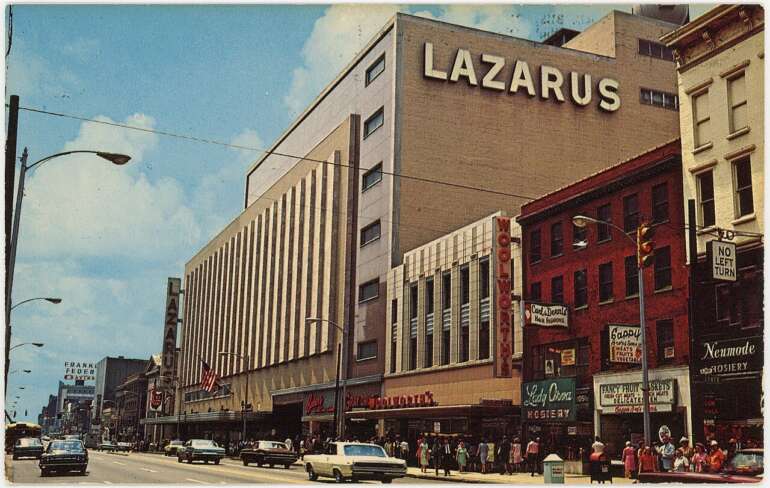
Lazarus made its headquarters in Columbus, Ohio and for more than 150 years they dominated the Midwest department store market. They were pretty much the cornerstone of every major mall in the city at the time. Northland, Eastland, Westland, and City Center Mall were all carried on the backs of Lazarus stores.
Eventually, parent company Federated folded all of its regional nameplates into Macy’s. Lazarus stores became Lazarus-Macy’s in 2003, and in 2005 the name disappeared from storefronts for good.
Northland Mall
Northland was the first of the ‘land’ malls, opening at Morse and Karl roads in August 1964 as an open-air shopping center anchored by the city’s biggest Lazarus branch and the first Sears in Central Ohio. Roughly 150,000 people came through in the first three days. The mall got its roof in 1975, and for the next few decades it was where the north side shopped.
Polaris opened in the fall of 2001 and pulled all three of Northland’s anchor stores away within a year. The mall closed for good in October 2002, and the wrecking crews arrived in 2004. The site is now Northland Village, where a Menards and a Kroger share the old footprint with state offices and the Franklin County Dog Shelter.
City Center Mall

At one point City Center served as the central crux of the city. It was the go-to shopping destination for anyone in the Columbus area. The Christmas performances and displays were legendary and its three stories of shops and storefronts were the envy of every other commercial center in Columbus. Ultimately, its heyday ended and business slowed to a trickle.
The city bought the struggling mall in 2007, and the doors closed for good in March 2009. Capitol South Community Urban Redevelopment Corporation and Columbus Downtown Development Corporation tore down the mall and converted it into the park we all know and love today, the Columbus Commons, which opened in 2011.