Slate Run Metro Park is the one with the farm. Down State Route 674 south of Canal Winchester, Metro Parks runs a working 1880s farm where staff in period clothing plow with Percheron horses and cook on a woodstove, and raise the same breeds of sheep, pigs, chickens and turkeys an Ohio farm family kept 140 years ago. Every spring the barn fills with lambs and piglets, and admission has been free since 1990.
The farm takes up about 150 acres. The other 1,500 hold a restored wetland where sandhill cranes nest, a 14-acre fishing lake, the only covered bridge in a Metro Park and seven hiking trails through some of the best fall color in the district. This is the one park guide for Slate Run, part of the guide to every Columbus Metro Park. It covers the farm, the baby-animal season, every trail, the wetlands and lake, the picnic areas, the kid and dog rules, and what changes with the seasons.
Latest from the park (September 2026): Fall Fest is on October 10th this year, from 11am to 3pm at the Buzzard’s Roost Picnic Area, and the Fall Fest guide has more on the day. The farm’s spring lamb program, Sheep on the Farm, ran on two April afternoons this year.
| Slate Run at a glance | |
| Address | 1375 State Route 674 North, Canal Winchester. The wetlands have their own entrance at 11140 Winchester Road, Ashville. |
| Park hours | 6:30 a.m. to dark, year round |
| Farm hours | Closed Mondays. April through September: 9 a.m. to 6 p.m. Tuesday through Thursday and Sunday, 9 a.m. to 7 p.m. Friday and Saturday. October through March: 9 a.m. to 5 p.m. Tuesday through Thursday and Sunday, 9 a.m. to sunset Friday and Saturday. From January through March the grounds and barn stay open but some buildings close and programs pause until April. |
| Cost | Free, farm included |
| Size | 1,705 acres, the fourth-largest Metro Park |
| Trails | Nine trails from 0.3 to 2.1 miles. Seven are open to everyone on foot, one is for horses only, and one is inside the reservable day camp. |
| Dogs | Leashed (6 feet max) on the Covered Bridge, Lake and Shagbark trails, in the picnic areas, in parking lots and on park roads. Not on the other trails or at the farm. |
| Kids | The farm, a 7-acre natural play area, playgrounds at both picnic areas and two children’s fishing docks on the lake |
| Restrooms | Both picnic areas |
| Phones | Park 614-329-1392. Farm 614-833-1880. |
Slate Run Living Historical Farm

The farm is set in the 1880s and it works like one, with visitors walking through. The staff and volunteers plant, harvest, cook, can, make soap and butcher using the tools and methods of that decade, and what they grow feeds the people working there. Walk into the farmhouse kitchen and someone is usually cooking dinner on the cast-iron woodstove. Walk into the barn and the horses are being harnessed for the afternoon’s field work.
The Gothic Revival farmhouse was built in 1856 by Isaac Fridley, and the big barn in 1881 by Samuel Oman, a later owner. Metro Parks restored both before the farm opened in 1981, with Amish carpenters doing the barn. The house tour takes in the parlor and the kitchen, plus the living room. The parlor has a rosewood square grand piano signed by its maker in 1868 and a pump organ from the 1870s; the kitchen’s woodstove gets taken apart twice a year and moved out to the summer kitchen so the house stays cool in July and August. Around the yard are the granary with its corn cribs, a tool barn with a working forge, a smokehouse, a root cellar and an outhouse.
The animals are the same breeds the Fridleys and Omans would have known: Merino sheep, Poland China pigs, Buckeye and Minorca chickens, Slate turkeys, Muscovy ducks, Toulouse geese and short-horned cattle. The Percheron horses are the ones with names. There are usually four on staff, and they work in pairs on the plows, harrows, cultivators and the manure spreader. The hardest days for them are threshing days in July, when a pair walks in a circle to power the machine that separates the wheat.
Kids can help with real chores here, like shelling and grinding corn or sweeping the porch. The yard has stilts and a marble game, and the farm’s staff hand them out. For the first ten years the farm charged a small admission; it’s been free since 1990. It’s closed on Mondays, and from January through March the grounds and barn are open but some buildings close until the season restarts in April.
Baby animals in spring
Spring is the reason a lot of families make the drive. The Merino ewes lamb in spring and the lambs stay in and around the barn where you can get close. There’s usually a litter of Poland China piglets at the same time, and the farm’s chickens and turkeys hatch chicks around the beginning of May. The farm’s own blog describes the routine: piglets born with almost no fat that will weigh 350 pounds by December, and purple martins moving back into the gourd houses.


The one dated event to plan around is Sheep on the Farm, an April afternoon (two of them in 2026, April 19 and 25, from 1 to 3 p.m.) when the staff shear the flock and let you meet the lambs. It’s free like everything else at the farm. The farm posts new arrivals on its Facebook page, and the Metro Parks program search lists the farm’s dates.
All nine trails

Slate Run’s trails come in two kinds. The ones around the farm and the lake are short gravel loops through ravines and old forest, and two of them are genuinely steep. The ones on the west side are long grass paths through the wetlands and the grasslands, built for birds more than for a workout.
| Trail | Miles | Rating | What it does |
| Covered Bridge | 0.5 | Easy, gravel, dogs OK | Crosses the 1895 Blackburn Covered Bridge and connects to the Shagbark Trail |
| Shagbark | 0.5 | Easy, gravel, dogs OK | Forest and meadow loop at the far end of the Covered Bridge Trail |
| Lake | 0.3 | Easy, paved, dogs OK | Short paved path to Buzzard’s Roost Lake |
| Five Oaks | 1.5 | Moderate to difficult, gravel | Drops through a steep ravine with black shale outcrops; the natural play area is off this trail |
| Sugar Maple | 1.3 | Moderate to difficult, gravel | Crosses Slate Run Creek and several steep hills |
| Kokomo | 1.5 | Easy, grass, dirt and boardwalk | Through the wetlands, with three observation decks and a 50x spotting scope |
| Bobolink Grassland | 1.5 | Easy, grass, ADA | Winds through the grassland to an observation deck over the wetlands |
| Sassafras | 2.1 | Horseback riding only | Forest and meadow bridle trail with its own trailhead on Duvall Road |
| Camp Starview | 1.7 | Moderate to difficult | Ravines and steep hills inside the day camp; open only to groups renting it |
The Covered Bridge Trail is the one to walk with kids or with a dog. The Blackburn Covered Bridge was built in 1895 over Brannon’s Fork in Muskingum County. When strip mining threatened it in 1967, a man named Arthur Wesner bought it, took it apart and rebuilt it on his own land, and in 1998 he gave it to Metro Parks. The park’s crew restored all 53 feet of it and built a trail around it just south of Buzzard’s Roost Lake. No other Metro Park has one.

Five Oaks and Sugar Maple are the hikes. Five Oaks goes down into a ravine where black shale shows through the hillside, and Sugar Maple crosses Slate Run Creek itself. Together they were the park’s original 2.5-mile nature trail when it opened in 1981, later split in two.
The wetlands and the cranes

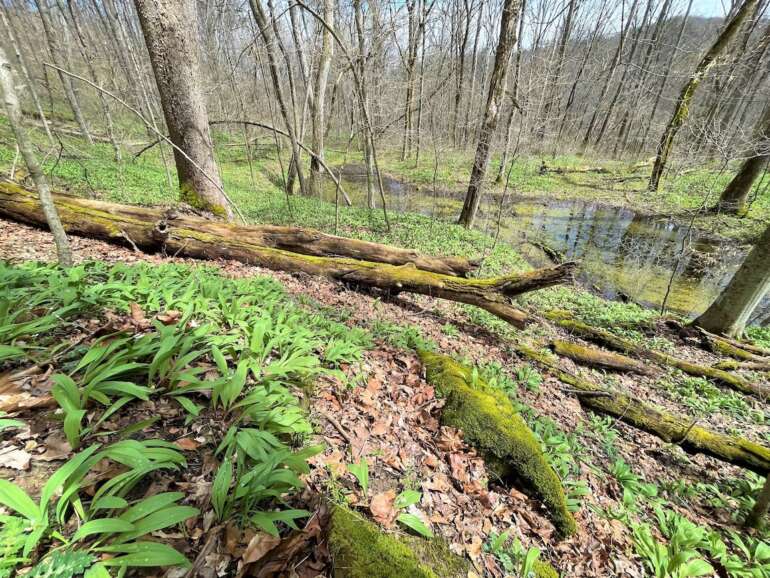
The west side of the park was farmland that had been a sedge meadow before settlement, and in 1999 Metro Parks and the Ohio Wetlands Foundation turned it back into one. Crews moved more than 100,000 cubic yards of dirt to build the cells and berms of a 156-acre wetland, the district’s first big restoration project. Within a decade sandhill cranes were nesting in it, the first known nesting pair in central Ohio in more than a century. They’ve raised colts there every year since. Least bitterns and blue-winged teal nest there too.
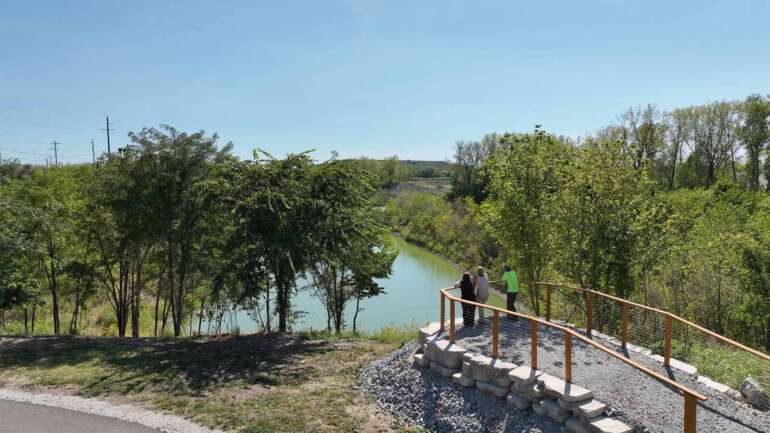
The Kokomo Wetland Trail loops through it on grass, dirt and 600 feet of boardwalk, with three observation decks. One of the decks has a permanent 50x spotting scope, so you can leave the binoculars at home. The Bobolink Grassland Trail connects the wetlands to the rest of the park through 135 acres of grassland managed for bobolinks, meadowlarks, Henslow’s sparrows and grasshopper sparrows, and it’s where Metro Parks has been reintroducing northern bobwhite quail since 2012. The wetlands have their own entrance and parking at 11140 Winchester Road in Ashville, which is the shorter way in if the birds are the point of the trip.
Buzzard’s Roost Lake
The 14-acre lake was dug in 1993 and stocked with bluegill and largemouth bass. Fishing is allowed, and there are two children’s fishing docks plus a lakeside boardwalk and an observation deck with a spotting scope. The lake was renovated in 2015 after aquatic weeds took over, so the depths and the water quality are back to what they were. The Lake Trail from the picnic area is paved and 0.3 miles, and dogs are allowed on it.
Picnic areas and shelters
Both picnic areas are first come, first served, free, and open with the park at 6:30 a.m. You keep a shelter as long as someone from your group stays at it.
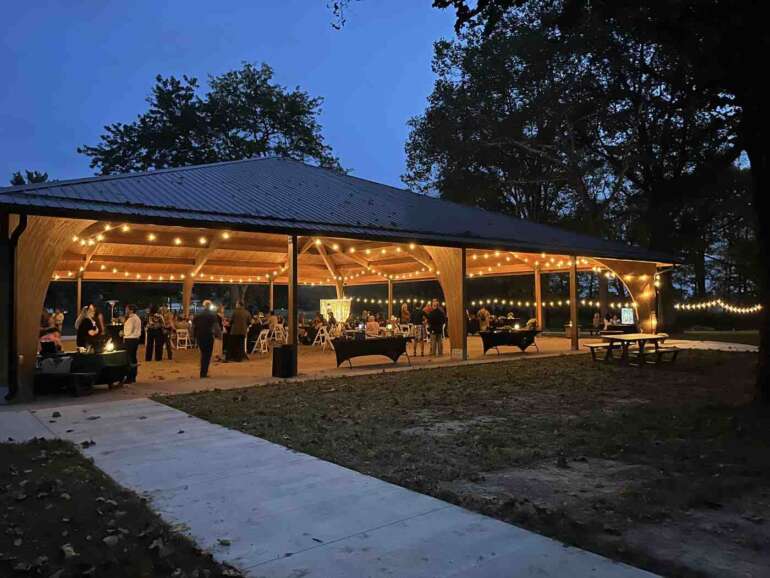
Buzzard’s Roost Picnic Area is the big one, beside the lake: an open shelter with seating for 200, four grills, electrical outlets, playfields, playground equipment, a drinking fountain and restrooms. Shady Grove Picnic Area is the original one from 1981, near the trailheads for Five Oaks and Sugar Maple: an open shelter for 80, three grills, outlets, a small playfield, a playground and restrooms. The farm has its own picnic area with eight tables and no grills.
Camp Starview, 55 acres in the northeast corner with its own entrance off Neiswander Road, is reservable by scout troops for day and overnight camping and by other youth and church groups for day use.
Bringing kids

Slate Run has plenty for a kid under ten, and the farm is only part of that. The farm itself is hands-on: pet the horses, watch the pigs, grind corn, try the stilts. Lambs and piglets come in spring and threshing in July. Metro Parks says up to 20,000 schoolchildren a year have come through on guided tours, and it books Farm School Tours for school and summer groups online.
The 7-acre natural play area is a wooded hillside with a creek along the bottom where kids can dig and climb without a structure in sight. Get there from the Shady Grove Picnic Area: walk past the observation deck on the Five Oaks Trail and down to the bottom of the hill. Both picnic areas have regular playgrounds, and the two children’s fishing docks on Buzzard’s Roost Lake are sized for a first cast.
Bringing dogs
Dogs are welcome on a leash no longer than 6 feet on three trails: Covered Bridge, Lake and Shagbark, which together make about a mile and a half of walking. They’re also fine in the picnic areas, the lots and on the park roads. They aren’t allowed on the other trails, in the wetlands or at the farm, where the livestock are. If a long dog walk is the plan, Walnut Woods and Three Creeks, both in Groveport, have dog parks.
What to do here by season
Spring. Lambs and piglets at the farm, the Sheep on the Farm shearing afternoons in April, the cranes back on the nest in the wetlands, and the farm’s full schedule restarting after the winter slowdown.
Summer. Threshing days at the farm in July are the best show of the year, with the horses walking their circle to power the thresher. The lake docks are busy.
Fall. Metro Parks says Slate Run has some of the best fall color in the whole district, and the sugar maples near the Fall Fest grounds and the trees bordering the wetlands are why. Fall Fest, a Slate Run tradition since 1998, brings hayrides, a corn maze, a pumpkin patch, archery and s’mores, all free, plus local vendors and food trucks. The Covered Bridge Trail in leaf season made the list of the best fall hikes near Columbus.

Winter. Metro Parks’ Winter Hikes series comes to Slate Run in January (January 11 in 2026), with refreshments at the Buzzard’s Roost Picnic Area. In February the park taps its sugar maples and boils the sap down at the farm for Maple Time, two February afternoons of syrup and candy making (February 22 and 28 in 2026). The farm runs on reduced hours from January through March, with the barn and grounds open but some buildings closed.
How Slate Run became a park
Metro Parks first looked at the land along Slate Run in 1963, when the district had only three parks and none of them large. It bought 1,662 acres between 1964 and 1968, then leased most of it back to the farmers who lived there while it saved up to build. A primitive day camp opened in 1971. The park itself opened in 1981 as the sixth Metro Park and the largest one at the time; today it’s the fourth largest behind Battelle Darby Creek, Clear Creek and Prairie Oaks.
The farm was always the plan. Of the 22 parcels that made up the park, the 212-acre White family farm had been worked continuously since 1805 and still had its 1856 house and 1881 barn standing. Metro Parks centered the restoration on the 1880s because most of the outbuildings dated from 1880 to 1910. The lake came in 1993 and the covered bridge in 1998. The bridle trail and the wetlands both followed in 1999.
Getting there
The main entrance is at 1375 State Route 674 North, Canal Winchester. The farm, both picnic areas, the lake and the covered bridge are all inside that entrance. The wetlands entrance is at 11140 Winchester Road in Ashville, the bridle trail has its own trailhead on Duvall Road, and Camp Starview’s entrance is off Neiswander Road.
For the park map and the program calendar, see the Metro Parks pages for Slate Run and Slate Run Living Historical Farm.