

Ohio is full of reminders that people were living, traveling, gathering, and making art here long before the state looked anything like it does today. We’ve got enormous earthworks, ancient quarries, and burial mounds, but there’s another piece of that history hiding in plain sight: petroglyphs.
Petroglyphs are images carved, pecked, or cut into rock. Unlike pictographs, which are painted onto a surface, these designs were literally worked into the stone. Across Ohio, Indigenous people left behind carvings depicting animals, people, footprints, snakes, and abstract shapes.
Unfortunately, plenty of Ohio’s historic petroglyphs haven’t survived. Some were destroyed, some are now underwater and others have become difficult or impossible to access.
But there are still several places where you can stand in front of the actual rock and see the carvings for yourself.
Leo Petroglyphs & Nature Preserve
If you want to see a whole collection of ancient rock art in one place, start here.
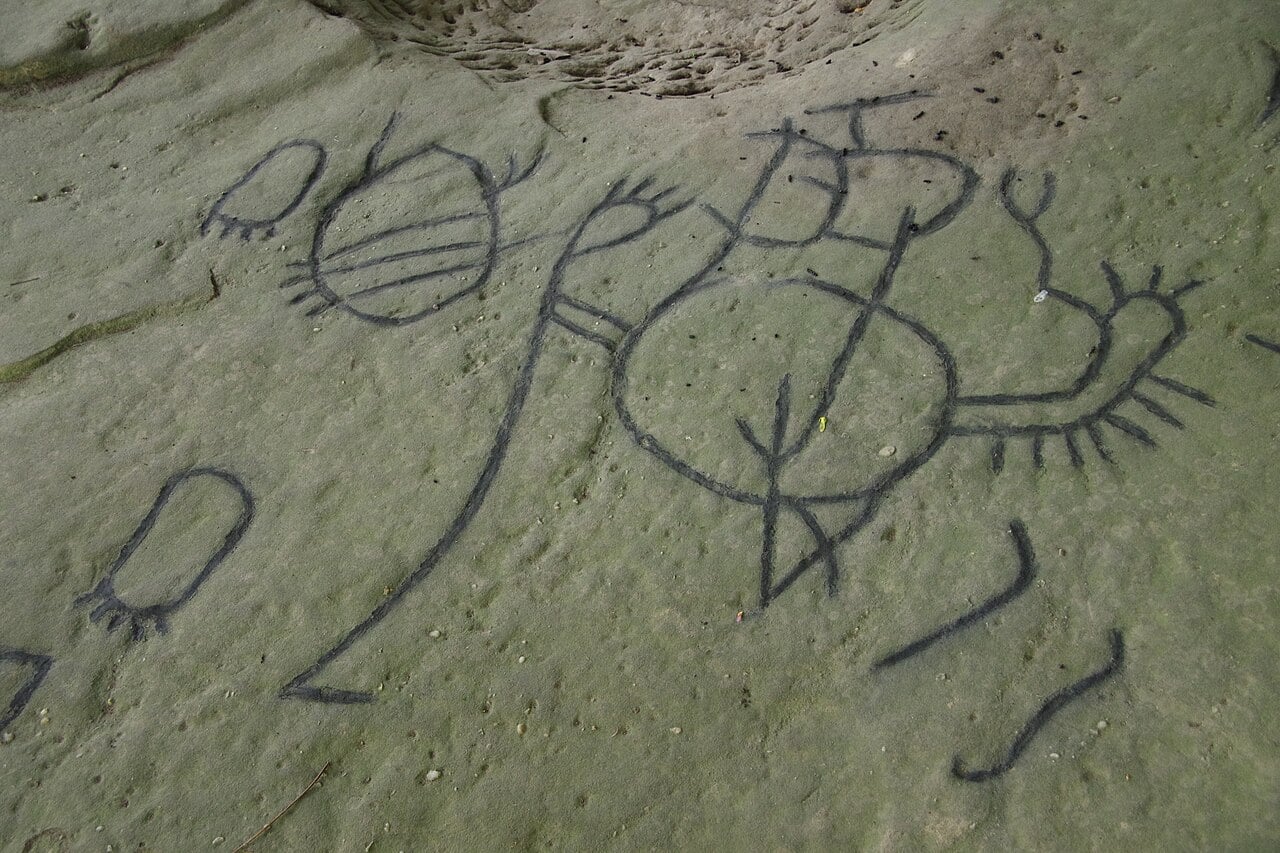
Tucked into a wooded landscape near the tiny community of Leo in Jackson County, the Leo Petroglyphs are carved into a large sandstone slab overlooking a gorge. The panel contains 37 known figures, including humans, birds, animals, footprints, a fish and a snake. One particularly distinctive carving depicts what appears to be a human figure with a birdlike body and antler-like features.
The exact age of the carvings isn’t known, but the Ohio History Connection says the weathering of the sandstone suggests they are probably no more than about 1,000 years old. They are generally attributed to the Fort Ancient culture, although the precise meaning of the individual images remains unknown.
And the petroglyphs aren’t the only reason to make the drive.
The site includes a roughly half-mile trail through a gorge, with sandstone cliffs ranging from about 20 to 65 feet high. There are also waterfalls, a rock shelter and plenty of scenery along the way.
The carvings themselves are protected beneath a shelter, with a viewing area that lets visitors get a close look without walking directly on the rock.
Plan your visit: Leo Petroglyphs & Nature Preserve is open during daylight hours and admission is free. The Ohio History Connection recommends allowing at least an hour for the visit.
MORE LIKE THIS: 13 Incredible Indigenous Sites & Events Around Ohio You Need To Experience
Inscription Rock Petroglyphs
You can combine your ancient rock art with an island getaway at Inscription Rock on Kelleys Island.
Located on the south shore of the island, Inscription Rock is a large limestone slab covered with American Indian symbols. The carvings include recognizable figures and designs that have weathered considerably over time. The Ohio History Connection believes the petroglyphs were created sometime between A.D. 1200 and 1600.
The story of the rock’s discovery is pretty wild, too. When it was rediscovered in 1833, portions of the rock were buried along the shoreline. Today, the entire surface is exposed and protected beneath a roof with a viewing platform.

Getting there is part of the adventure. Kelleys Island is accessible by ferry from Marblehead during the season, and once you’re on the island, Inscription Rock is open during daylight hours. The Ohio History Connection suggests allowing about 30 minutes for the site itself.
And while you’re there, you can add another completely different piece of geological history to the itinerary: Kelleys Island’s famous glacial grooves, where Ice Age glaciers scraped enormous parallel channels into the limestone.
MORE LIKE THIS: Step Back In Time On This Charming Ohio Island With Glacial Grooves & Petroglyphs
Barnesville Petroglyph
This one is a little more mysterious.
Known locally as the Track Rocks, the Barnesville Petroglyph sits on a sandstone boulder in the woods west of Barnesville. More than 100 carvings were documented historically, although only a portion remain visible today. The surviving designs include animal tracks, bird feet, human faces, human footprints, snakes and geometric shapes.
And nobody can give you a completely definitive answer about who made them.
Various theories have connected the carvings with different Indigenous cultures and time periods. Some of the designs have similarities to petroglyphs elsewhere in the Upper Ohio Valley, while the site’s location and imagery have prompted plenty of speculation about its purpose.

The site has also had a rougher history than Leo or Inscription Rock. Some carvings have been damaged or lost over the years, and fewer than 70 of the more than 100 recorded images are still visible.
The Barnesville Petroglyph is listed on the National Register of Historic Places and remains accessible to visitors, although it is a much less developed site than Leo or Inscription Rock. There isn’t a visitor center or museum waiting at the end of the road. If you visit, the important thing is to treat the carvings as the fragile archaeological site they are and leave the rock exactly as you found it.
MORE LIKE THIS: Carved in Time: The Mysterious Petroglyphs Hidden Near Barnesville
What Happened to Ohio’s Other Petroglyphs?
Archaeologists have documented numerous Indigenous petroglyph sites across Ohio, particularly along the Ohio River and its tributaries. A 2023 study of Ohio rock art identified 20 documented precontact petroglyph sites in the state.
But documented doesn’t necessarily mean visitable.
Some of the old sites were destroyed as roads, canals and other development projects changed the landscape. Others were carved into rocks along the Ohio River that are now underwater because of dams.
Even Blackhand Gorge near Newark once contained an important petroglyph depicting a hand. The carving and many other petroglyphs at the site were destroyed in 1828 during construction of the Ohio and Erie Canal. The carvings were documented before they disappeared, which means we know something about what was there even though there’s nothing left to visit today.

There were also extensive petroglyphs along the Ohio River near East Liverpool and Wellsville. Some of these carvings were only visible when river levels dropped, while others disappeared beneath the water after dams were constructed. Historic drawings and photographs are some of the only records that remain.
That’s part of what makes these remaining sites worth visiting. The carvings are still there, even when the stories behind them aren’t completely understood.
So if you’re looking for something a little different to add to your Ohio travel list, these are some pretty fascinating places to start. Just remember that you’re visiting protected archaeological sites, so look, take photos, and leave the carvings exactly as you found them.

