Public funding for the arts across the United States dipped in 2026, but the full picture is a little more complicated. In the Midwest, including Ohio, some states are increasing support even as overall investment trends downward.
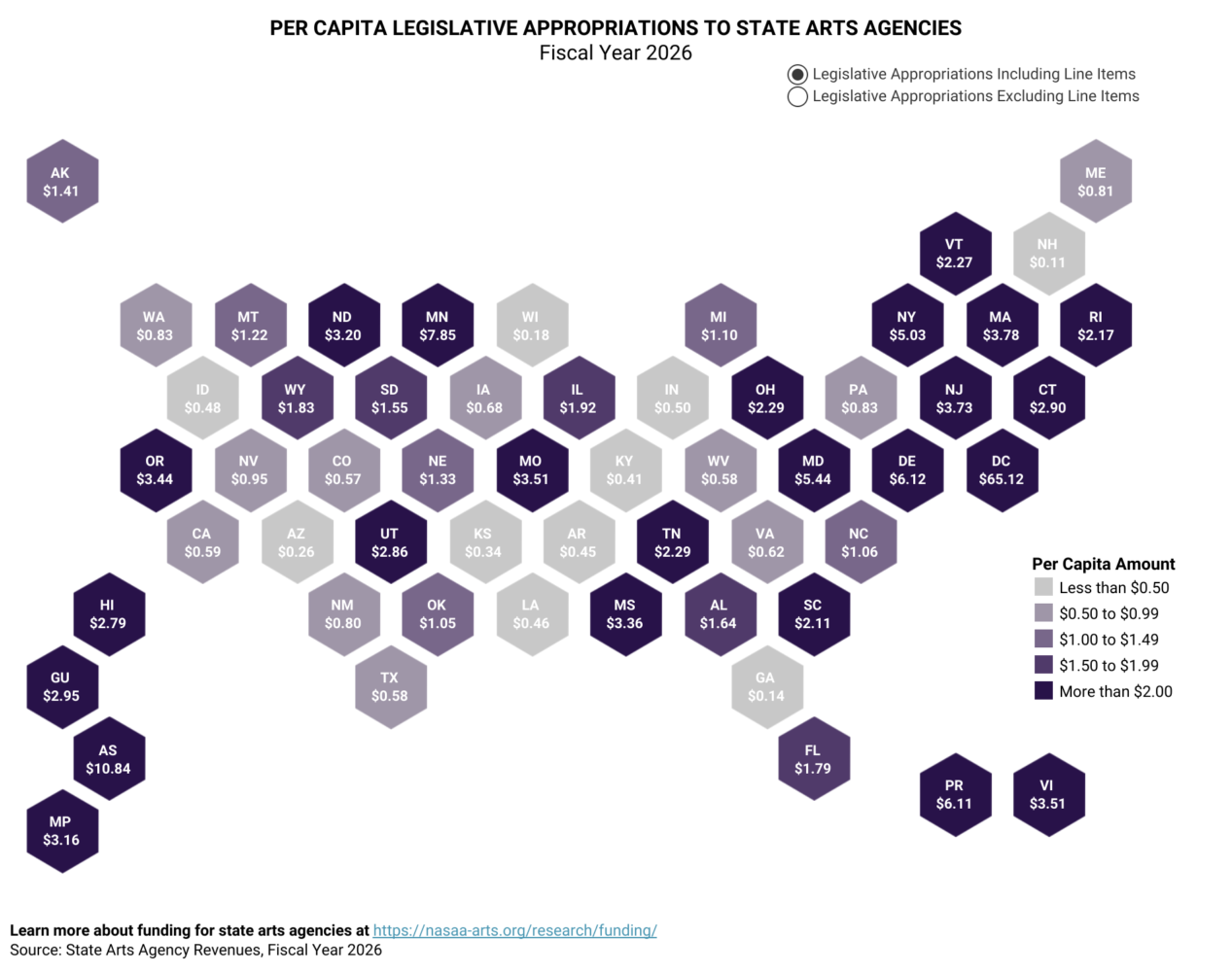
A new report from the National Assembly of State Arts Agencies, highlighted by regional nonprofit Arts Midwest, shows that states collectively appropriated about $646 million for arts agencies in fiscal year 2026. That is down from $694.3 million in 2025. On a per-person basis, the investment comes out to $1.88 nationally, compared with $2.02 last year.
Those dollars help support more than 25,000 grants each year for artists, schools, nonprofit organizations, and local governments. The funding supports arts education programs, performances, exhibitions, and cultural initiatives in communities across the country.
For cities like Columbus, that funding can help sustain theaters, galleries, festivals, and youth arts programs that shape our cultural identity.
A mixed picture across the Midwest
Across the nine states served by Arts Midwest, legislative appropriations to state arts agencies totaled $113 million in 2026, a 9.5 percent decrease from 2025.
Average arts funding in the Midwest now sits at $1.90 per resident, about 23 cents less than last year.
Still, funding levels vary widely from state to state. Indiana saw one of the sharpest drops, with arts appropriations falling 37 percent year over year. Iowa increased funding by 26 percent, though it still ranks near the bottom nationally in per capita investment.
Minnesota continues to stand apart from the rest of the region. The state spends $7.85 per resident on the arts, the highest level in the country, thanks largely to a constitutional funding stream dedicated to arts and cultural heritage.
Ohio is trending upward
In contrast with the broader decline, Ohio saw a modest increase in arts funding this year.
The state currently spends about $2.29 per resident on the arts, placing it 10th in the nation and marking a 4 percent increase from 2025.
That funding flows through the Ohio Arts Council, which distributes grants to artists and organizations across the state. Those grants help fund community arts programs, public art projects, arts education initiatives, and cultural events.
The bigger concern: long-term erosion
While year-to-year changes attract attention, researchers say the larger trend is more concerning.
Even though arts funding today remains above pre-pandemic levels in raw dollars, its real value has steadily declined when adjusted for inflation and population growth.
According to the National Assembly of State Arts Agencies, today’s $1.88 per capita investment equals about $1.04 in 2001 dollars. In 2001, per capita arts funding was $1.57, meaning the real value of state support has declined 34 percent over the past 25 years.
That shift matters because state arts agencies serve entire populations.
As states grow and costs rise, maintaining access to arts programs requires funding that keeps pace with those changes.
“The arts are not an optional add-on,” said Torrie Allen, president and CEO of Arts Midwest. “They are part of the civic and economic infrastructure that makes states competitive and communities whole.”
For now, Ohio’s increase places it among the stronger arts funders in the Midwest. But the national trend shows how quickly the impact of those investments can shrink if funding does not keep up with economic realities.
You can view the FY2026 State Arts Agency Revenues Report here.